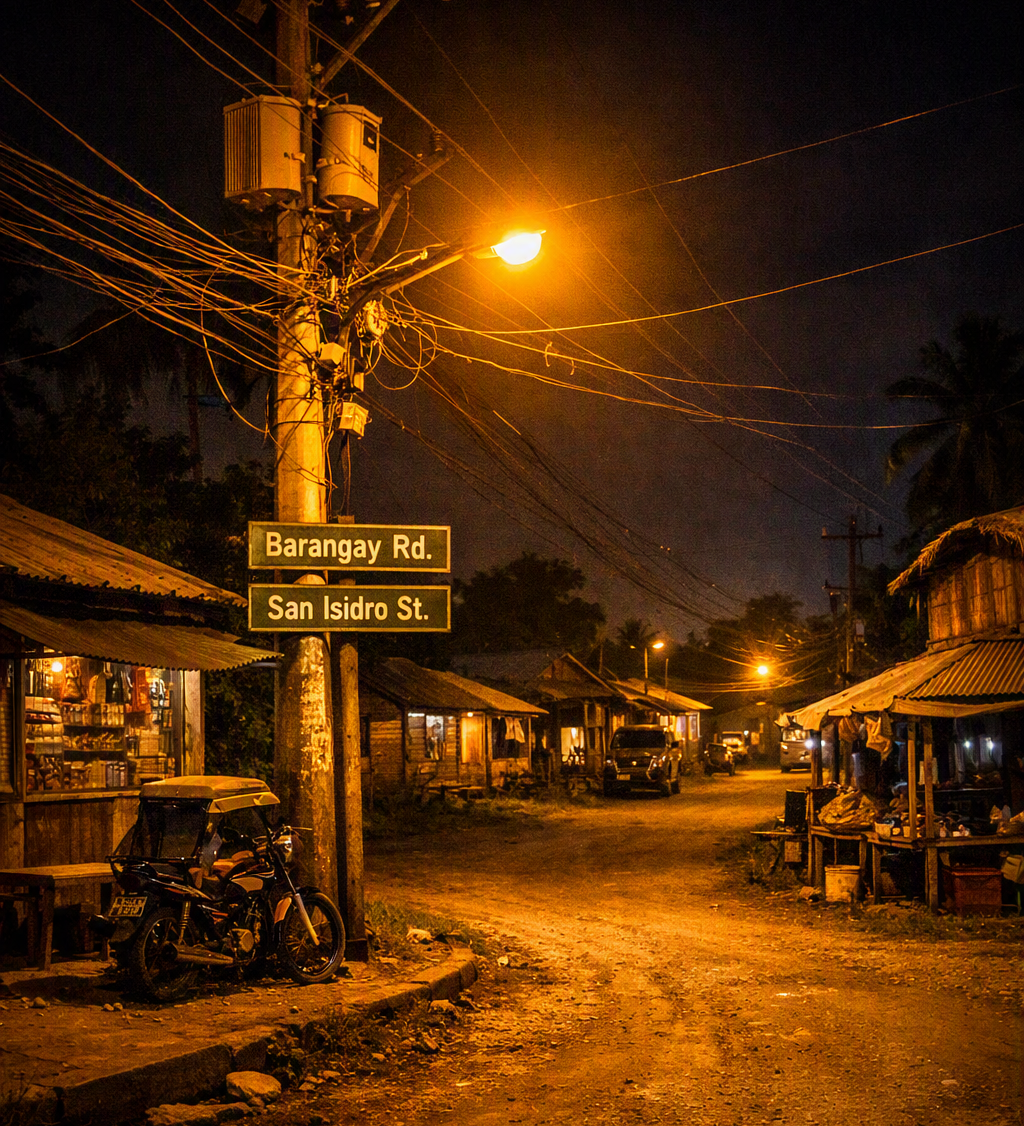
My mother sat on a chair, wearing her green duster, inside a cozy bungalow that felt achingly familiar. Her graying hair was combed away from her face, revealing the wide, familiar plane of her forehead. I knew she had cancer. The knowledge sat quietly between us, like another person in the room. But that day, she looked better. She was upright. She was awake. She was not the frail body I had grown used to seeing in bed, folded into pillows and pain.
I chatted with her about all sorts of things before stepping out to buy something for her at the sari‑sari store down the street. Outside, night had already settled. The store glowed faintly beneath the yellow light of a Meralco post, that tired kind of light that made everything look soft around the edges. I bought what I needed and returned to the house, ready to continue the small devotion of caring for her. There was sadness, yes, but there was also a strange and tender comfort in it: the comfort of being needed by her, of hearing her voice, of having an errand to run on her behalf.
And then, without warning, the scene split open. The warmth drained away. I remembered. My mother was dead. She had been dead for two months.
It was only a dream.
There was no bungalow; we live in a high‑rise tower of concrete and elevators. There was no sari‑sari store waiting at the end of a gentle street; our road is urban, loud, and unbothered by grief. The soft, familiar world I had been standing in belonged to the movie I was watching before sleep pulled me under.
And near the end, my mother could no longer sit upright in a chair at all.
The dream gave me the simple mercy of presence: my mother in a chair, alive enough to need something from the store, still reachable by a doorway and a short walk under yellow light. For a brief moment, it fulfilled a longing I had not known how to name: the longing to have her near again, even in that fragile, fading state. But when I realized it was only a dream, waking felt like losing her a second time. The comfort I had felt became its own kind of ache, because I knew that brief nearness, that tender illusion of her presence, would remain forever trapped inside a dream.
They say losing a parent changes your life. I used to understand that only as a phrase people offered in sympathy, solemn and sincere but still distant. Recently, a friend asked me how life feels after her death. I told her it feels like a dividing line. My life has quietly split itself into two eras. Just as history is marked by before Christ and anno Domini, mine is now measured by Before Mom and After Mom.
Recently, I published a paper in a journal. When I heard that it was finally out, my first instinct was to copy the link and send it to my mother’s inbox. The impulse came so naturally that, for a second, grief forgot to remind me. But just as I was about to share it, the truth returned with its quiet cruelty: there was no one waiting on the other side of the message, no one who would open it with pride, no one who would make my small victory feel larger simply by knowing it. I realized then how much I had taken for granted the ordinary joy of telling my mother good news.
The same thing happened with the renovation of my house. The bathroom fixtures I had bought had just arrived, and I took a picture of them almost automatically, already reaching for the old habit of flaunting my big purchases to her. I used to send her photos without captions, just to make her guess, knowing she would call to ask what they were. Then, once she understood, she would be genuinely happy for me, not because bathroom fixtures mattered, but because they were mine; because they meant I was building something; because my happiness was reason enough for hers. Now the photos remain silent in my phone’s album, with no one to receive them, no one to ask, no one to turn them into a story worth telling.
Perhaps this is what grief truly changes: not only the absence of the person we have lost, but the shape of every ordinary day that follows. It teaches the body to reach for someone who is no longer there, the hand to hover over a name it can no longer message, the heart to keep loving long after love has nowhere visible to go. I am beginning to understand that moving forward does not mean leaving my mother behind. It means carrying her differently: in the good news I still want to tell her, in the photographs I still want to flaunt, in every small triumph made larger by the memory of her pride. I may never learn how to live entirely in After Mom, nor would I want to. Some part of me will always be walking back toward that chair, beneath the yellow light, carrying something home for her. And perhaps that is how I will go on: not by escaping the life before she died, but by letting the love from Before Mom illuminate whatever remains of After Mom.


Leave a Reply